

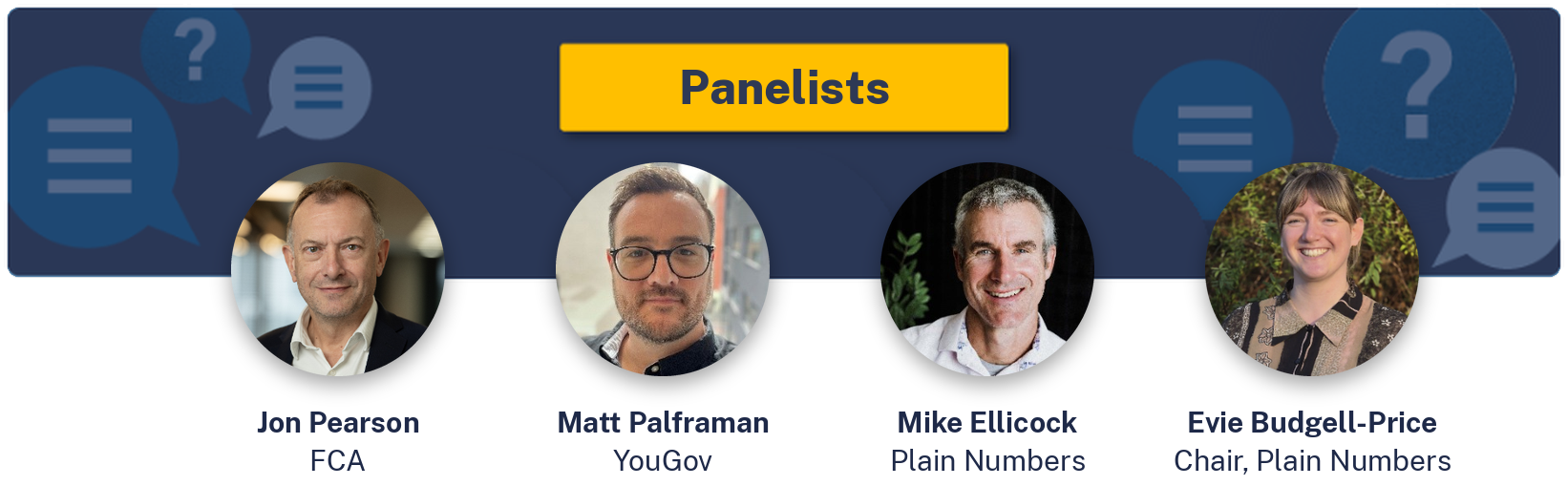
On 17 November 2026, our panel from the FCA, YouGov and Plain Numbers discussed new research testing five everyday financial communications, comparing the originals with versions rewritten using the Plain Numbers Method. Watch the replay and read the key takeaways below.
Watch the recording here
Five key takeaways from our expert panel
1. Don’t assume customers understand, test it38:30 mins in
Some firms say they test communications but have limited evidence to demonstrate it, and others rely on sales data or an absence of complaints. That’s a blunt tool, because customers who don’t understand may not know to complain. Testing can be proportionate and relatively simple, and the findings can be used to improve communications and journeys.
Jon Pearson, Head of Department for Consumer Policy and Outcomes, FCA
2. Asking people whether they understood tells you something – but not whether they actually understood it16:07 mins in
About 8 in 10 participants said the original communications were easy to understand, but only about a third could answer five simple questions about them correctly. The persistent debt letter was the starkest example: about 85% of participants said it was easy to understand, yet fewer than 1 in 10 answered all five questions correctly.
People often don’t want to admit they don’t understand something. Fewer than 3% of participants said they struggle with numbers, while national data suggests around half of UK adults have numeracy at or below the level expected of a primary school leaver.
Real testing means asking about the information customers need to make their decisions, with a robust sample of people who reflect your customers or the likely audience, and repeating it regularly to see whether changes are working.
Matt Palframan, Head of Financial Services Research, YouGov
3. Measuring isn’t the same as improving34:52 mins in
Most firms know that testing and outcomes monitoring are necessary, and that they need to report on them, for example in their annual board reports. But there’s a missing piece: actually improving communications.
There’s a weighing scales analogy; standing on the scales doesn’t change your weight, you have to take action, and in the same way, testing communications doesn’t improve them. There is an added issue - many firms appear to be using ‘faulty scales’, in that they don’t recognise that their customers’ understanding falls short, and that they need to act.
There’s some great work going on within financial services to improve customer outcomes, but every firm has work to do here, and there’s still a long way to go for the whole industry.
Mike Ellicock, Chief Executive and Founder, Plain Numbers
4. Even ‘bad news’ can be delivered in a way that shows the firm is on the customer’s side22:22 mins in
The car insurance letter told customers their premium was going up, yet participants who read the Plain Numbers version were more likely to agree the firm was acting in their best interests: about half agreed (49%), compared with about a third (37%) for the original.
It shows that clearer communications do more than improve understanding of the key information. They change how customers see the firm. That matters because, in YouGov’s Consumer Duty Index, customers seeing a firm as acting in their best interests is the strongest driver of advocacy, yet the lowest scoring measure across the industry.
Matt Palframan, Head of Financial Services Research, YouGov
5. Start with the communications you’re already changing40:52 mins in
If the number of communications feels overwhelming, don’t wait until you can improve all of them. Improving some now is better than improving none. When a communication is being rewritten anyway, use that moment to build the Plain Numbers Method into it, rather than waiting for testing before you start.
Then build on it, turning it into a more systematic process and making it part of business as usual. Smaller firms can also work with Plain Numbers, with new offerings designed for them becoming available in 2027.
Mike Ellicock, Chief Executive and Founder, Plain Numbers

Focus on your sector
In 2027, we’ll run sector-specific webinars for pensions, insurance and consumer credit. Each one pairs what the research found in your sector with what’s changing in your industry, and what that means for customer understanding.
Here's what you can expect:
Understanding and sentiment
How much customers understood the comms in your sector, and how they felt about them, before and after they were rewritten.
Beyond the report
Extra findings and examples from your sector that we didn’t have room to include.
The year ahead
What’s changing in your sector in 2027, and what it means for the comms you send.
From findings to action
A practical look at how firms in your sector can test and raise understanding of their own comms.